
1. Do NOT exceed compressors rated Duty Cycle!
The majority of California Air Tools OIL-FREE Air Compressors have a 70/30% Duty Cycle Rating . Meaning the compressor motor/pump(s) can run 70% of the time during a standard work day, but be off (not running) 30% of the same work day – this is considered intermediate usage and most air tools and machines are rated for intermediate usage (not continuous).
Always consult the air tool or machine manufacturer for the correct OPERATING air flow volume/ CFM (cubic feet per minute) OR l/min (liters per minute) air flow requirement.
Baseline Rule: With respect to air compressor use/operations, 70/30 Duty Cycle rated motor-pumps should not be allowed to continuously operate for more than ~60 minutes (i.e. where you hear the motor-pump running the whole time), otherwise permanent motor windings damage may/will eventually occur in time. After ~50-60 minutes of continuous running (60 mins maximum!), all OIL-FREE air compressors with 70/30 Duty Cycle rating, should be allowed to cool down for 15-20 minutes, then compressor operations may repeat. Moreover, for 1 HP motor-pump air compressors it is suggested to avoid running continuously more than 30-45 minutes at a time. Usage assumptions are based on a standard 8 hour work day, 5 days/week.
For Continuous Operations: 2 Hp, 4 Hp, 5 Hp and 6 Hp models may operate continuously from 1 to 4 hours if the air flow volume cfm (@ desired PSI) is divided by 2 (i.e. HALF THE RATED CFM @90 PSI) as this will allow the motor-pumps(s) to cycle ON/OFF on a regular basis allowing the motor windings to cool down regularly. Divide by 3 for 4-8 hour operations. Divide by 4 for longer than 8 hours/day. Excessive prolonged or Unattended compressor operations is not suggested and may void product warranty should a compressor air runaway state issue occur, such as a major leak. As a Baseline Rule, per above, the motor-pump(s) should never be heard running continuously for more than 1 hour (except for select Industrial Series). For example, if the compressor cycles ON for 2.5 minutes and is then OFF for 5 minutes, and repeats this cycling, then this is usually considered satisfactory operation for up to a few hours at a time (i.e. Dental Office/ Milling/CO2 Laser Cutting/CNC/Restaurant/Manufacturing/Packaging systems, etc). NOTE: If tooling CFM flow is unknown then it is suggested to either measure with a cfm flow meter or adhere to the 60 minute maximum motor-pump(s) Running ON time.
Exception: select Industrial BELT DRIVEN/OILED air compressor motors (i.e. 60037BD, 80050BD) are designed and may safely run continuously for up to 8 hours at a time. Select Industrial OIL-FREE air compressor motors (i.e. 60065C, 80060C) may safely run continuously up to 2 hours at a time, depending on PSI and CFM levels. The 20020CR Air Compressor is rated for 100% duty cycle and may run continuously for 8-12 hours.

For example, if your equipment requires 3.8 cfm @90 PSI (or 108 liters per minute) and you plan on running for more than 1 hour per day continuously, then you will need to obtain a compressor with a minimum specification of 7.4 cfm (this would be a 4 Hp model). If you plan to run more than 6 hours per day continuously, then multiply by 3, for a minimum compressor specification of 11.4 cfm @90 PSI (this would be a 6 Hp model).
CONTINUOUS RUN GUIDELINES by Horsepower
2 Hp Ultra Quiet Compressor (@90 PSI)
– may run at 3.0 cfm for up to 1 hour max; may run up to 5.0 cfm for 30 mins max
– may run continuously at 2.0 cfm for 1-4 hours
– may run continuously at 1.5 cfm for up to 6 hours
NOTE: 2.0 HP models cannot maintain 100 PSI (or higher) continuously for any longer than 5-10 minutes; 4.0 Hp models and above are only suggested.
4 Hp Ultra Quiet Compressor (@90 PSI)
– may run at 7.0 cfm for up to 1 hour max; may run up to 10.0 cfm for 30 mins max
– may run continuously at 4-5 cfm for 1-4 hours
– may run continuously at 3.3 cfm for up to 8 hours
– may run continuously at 2.5 cfm for up to 10 hours
6 Hp Ultra Quiet Compressor (@90 PSI)
– may run at 12 cfm for up to 1 hour max; may run up to 14.5 cfm for 45 mins max
– may run continuously at 7.2 cfm for 1-4 hours
– may run continuously at 4.8 cfm for up to 8 hours
– may run continuously at 3.6 cfm for up to 10 hours
The majority of air tools and machines are rated for intermediate usage (not continuous). Always consult the air tool or machine manufacturer for the correct OPERATING air flow volume/ CFM (cubic feet per minute) OR l/min (liters per minute) air flow requirement.
2. Do NOT pull on Safety Relief Valve! (i.e. this valve has the ring attached) as this will permanently damage the safety relief/pressure valve if used too often to bleed air out of tank. Upon initial unit purchase, it’s ok to test one (1) time to verify relief operation. Majority of California Air Compressor Safety Relief valves will automatically open at ~140 PSI (some select models at ~150 PSI). Pressure Pot relief valves open at ~80 PSI. Only use the manual ball drain valve or your air tool to remove air from the tank. ‘AD’ Units equipped with an Automatic Drain Valve will evacuate water and a small percentage of air on a regular basis.

3. Remove water from the tank on a regular basis! Not doing so can cause inadequate pressure problems. Open Manual Ball Drain valve at base of unit to let water condensation buildup out.

Automatic Drain Valve (AD) equipped units will remove water from the tank on a regular basis.

NOTE: 80% & 98% Dry Air Models (i.e. DCAD/DCADC) feature a Manual Ball Drain & Strainer w/Built-in Automatic Drain Valve. To manually drain the tank, turn the Strain Relief cap Counterclockwise and turn the black lever 90 degrees to release water, then close. Thoroughly clean strainer/mesh (located inside) of particulates; reattach Strain Relief cap and tighten Clockwise.
4. Do NOT Hot Plug the unit! (i.e. pull power cord from wall receptacle and then plug into another receptacle). This will usually cause the motor to start HUMMING LOUDLY and may permanently damage the motor-pump assembly.
5. Ensure Filter(s) and Filter Tube(s) is attached to motor! This will ensure the unit runs as quiet as possible. 1 Hp motors use one filter, 2 Hp motors use 2 filters.

6. Do NOT pull on power cord or air hose to move your unit around! This can damage the electrical connections and/or allow air to leak from air hose/coupler fittings.
7. Avoid connecting air compressor to Remote Power Switches! Only California Air Tool models equipped with an electronic unloader valve (pictured below) are generally safer for these types of applications otherwise permanent motor-pump damage may occur. All California Air Tool products are designed for attended operations only (i.e. during working hours and with personnel present). See #9 below.

8. It is suggested to add Teflon tape to Air Hose threads! (i.e. remove Industrial Male 1/4 NPT and Industrial Female 1/4 NPT couplers from your air hose and add Teflon tape to 3/8″ threads – this will help prevent air leaks and reduce compressor motor-pump(s) running time. Industrial Hybrid Air Hoses (1/4″ NPT) with fittings are available.

SUPPORT VIDEO – How To Regulate Output Pressure on Your Air Compressor
SUPPORT VIDEO – How to Connect Air Hose to Air Compressor

TIP: All 20 Gallon 4 Hp models and smaller include an Industrial Female (1/4″ NPT) “Push-to-Connect” air port fitting(s). To connect to air compressor use an INDUSTRIAL MALE (1/4″) fitting. Ensure tank is empty before attempting to connect air hose otherwise it will be VERY difficult to push against 120-125 PSI pressure.
NOTE: Larger models typically have 3/8″ NPT or 1/2″ NPT air port connections.
9. Do NOT operate any California Air Tool unit in Severe Elements! This includes outdoors in the rain (high levels of precipitation), below freezing (<32F — though many customers have indicated California Air Tools models run rather well in sub freezing temperatures), excessive heat environments (i.e. >90F) and high-dust & particle environments (i.e. ingestion into motor-pump). Generally units should operate below 85F (when used for long periods of time) otherwise motor-pump overheating could occur and the internal motor-pump’s thermal fuse may suddenly shutoff the unit off for ~10-15 minutes.

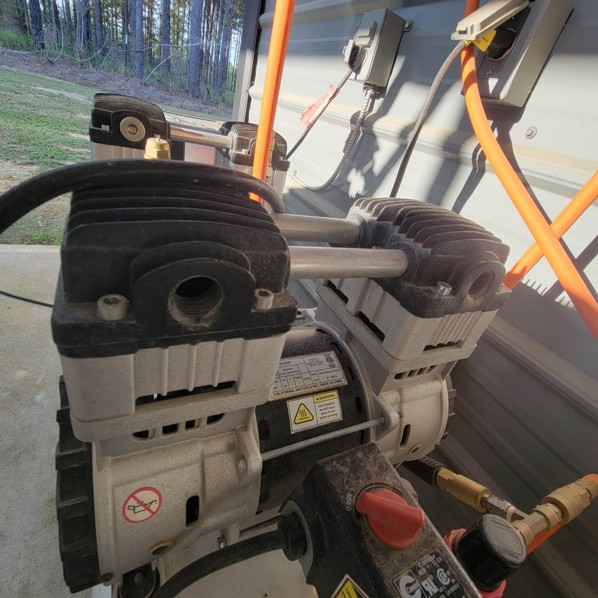
10. Do NOT operate unattended!
Attended Operations Only: All California Air Tools products are designed for standard work day environments with attended operation only and are not designed for 24/7 and/or unattended operational environments. Unattended operations is not suggested for safety reasons as motor-windings may become excessively hot (and may fail) if compressor runs higher or longer than the product’s rated duty cycle (i.e. due to unknown cfm rates or if a sudden rapid air leak/loss in the application/tooling system occurs). The is commonly referred to as an ‘Air Runaway State‘ and will often/eventually result in Motor/Pump(s) failure if constant cycling should occur while no-one is present to turn the the compressor off, as soon as 8 hours.
NOTE: While all motors have a thermocoupler (internal fusable link) to temporarily disable power, these only deactivate power while the motor is hot, exceeding a given temperature threshold (i.e. above 235F or similar); as soon as the motor cools down (as soon as 10 minutes) the motor reactivates automatically — thus an ‘Air Runaway State‘ or condition will result in constant cycling until power is removed from the compressor and the air leak(s) is corrected.
Case Example: Dry Air System failure (pictured below) due to compressor running 24/7 and left unattended for several months without any maintenance (water tank was not drained & dry air system clogged; desiccant flowed out side of dryer system tower and down the wall):

11. Do NOT operate unit on it’s side! Generally all California Air Tool units need to operate vertically, with no more than a 15 degree tilt with respect to gravity. All single-stage and two-stage motor-pumps have 2 pistons that move up and down rapidly inside the motor.
12. Avoid connecting unit to GFCI electrical outlet! Some GFCI receptacles (found in many newer or upgraded homes today) could interfere with air compressor unit function if too long of an extension cord is used; switch to another electrical outlet if this occurs.
13. Do NOT use unit with extension cords greater than 25′ in length! Ensure you have a proper cord gauge rating (i.e. 10/12/14) and unit is properly grounded.
14. Do NOT remove or replace Industrial Female fitting as this will void your warranty. The Air Compressors Female fitting (or fittings) is attached with high-grade RED locktite to the manifold and can only be removed using a Heat Gun (i.e. thoroughly heat up, then gently turn counter-clockwise to remove). The manifold assembly may easily crack and leak air if improperly modified/serviced. CAUTION: for servicing personnel only!

15. California Air Tools is the only air compressor manufacturer that includes an Easy Start Valve on many 2 Hp Air Compressors and above.
The Easy Start Valve blows air during startup (available on most 2, 4 & 6 Hp models). The valve will blow and release air from motor-pump for 2 to 10 seconds on average, then close – this is NORMAL. The purpose is to reduce Amp/current draw for easier air compressor start which helps prevent a circuit breaker from tripping. TIP 1: Ensure Ball Drain Valve is closed or air will continue to blow out of easy start valve. TIP 2: On majority of 220 volt oil-free compressor models, if voltage is too low (i.e. less than 210 volts) then easy start valve may continuously blow air and tank will not fill (tank gauge will read zero). See Video below:
16. If excessive water build-up is observed on tooling or in air line then it is suggested to install a separate air dryer:
- For light/intermediate use applications install a low-cost in-line desiccant air cleaner/dryer between compressor and tooling.
- For commercial/heavier use applications, up to 52 cfm, install a 110v 60z Refrigerated Air Dryer or 220v 60hz Refrigerated Air Dryer to remove 98% of water moisture from the air.
NOTE: If PDP (DEW POINT) below -20F (-29C) is required then a Desiccant ISO 8573 3.2.1 Dry Air Compressor (all 98% Dry Air models) would be required to achieve Class 2 Dry Air. 80% Air Dryer models and Refrigerated Dryers typically have Dew Points above +27F (-3C), or technically Class 4 Dry Air.

17. Connectivity Tip. If you purchased a 220 volt (60hz, 1-Phase) California Air Tools model (2 Hp or 4 Hp) the compressor model comes with a 6′ power cable with a NEMA 6-15P plug. The corresponding electrical wall plate/electrical receptacle with need to be either a NEMA 6-15R or 6-20R. A dedicated 20 Amp breaker is also suggested. NOTE: Acceptable voltage range is between 215VAC and 250VAC. If 208VAC is only available then a Buck Booster (208v to 230v transformer) will need to be acquired and installed to boost AC voltage from 208VAC to 230VAC.

18. Operate in Weather Protected / Clean-Air Environments only! Inside use only strongly recommended.
If water, rain, dust or particles including paint, saw dust (flammable!) become ingested into the motor-pump(s), the motor(s) may fail. For extremely dusty or high particulate environments it is suggested to wrap cheesecloth around air filters and/or along shroud edges to help prevent contamination of internal motor components.

19. Verify Proper Air Hose & Water Drain Hose Connectivity! Do Not connect 6mm or 8mm water drain hoses to air port fittings. Only Industrial air hoses (i.e. 1/4″ NPT) shall be connected to Female Industrial Push-to-Connect air ports. 8mm tubing should only be connected to Automatic Drain Valves or Condensate (dryer) ports. Likewise, 6mm tubing should only be connected to Dry Air system drain ports.


Example of proper hose connectivity – shown below is a typical 60040DCADC air hose connection to the 5um output filter/regulator (yellow hose, 3/8″ NPT at center), large dryer condensate tube connection to 98% dryer system (long black tube, at middle right) and 8mm auto drain tubing being routed into a plastic container (thin black tubing, at bottom left).
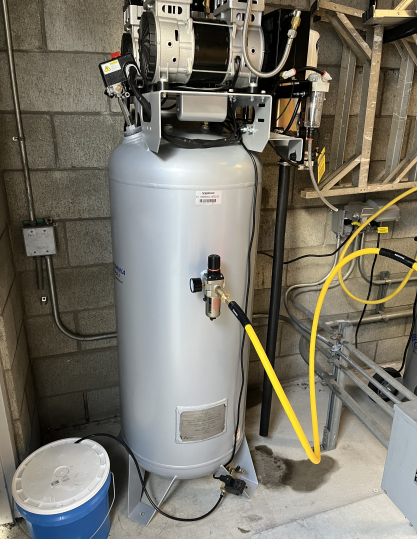
20. For 80% & 98% Dry Air Models Replace Desiccant every 4000 Operating Hours! (approximately 2 years with low to moderate use; for heavy compressor usage replace every 6 months to 1 year).
80% AIR DRYER UNITS: Replace 1 lb activated alumina/desiccant beads within a mesh bag located inside each vertical chrome tower (unscrew bottom to remove mesh bag, unzip the mesh bag, discard old desiccant beads and replace with new desiccant). Refer to servicing video.

98% AIR DRYER UNITS: Replace the Ultra Dry Service Kit cannister and replace with a new one (turn counterclockwise to remove). Refer to replacement video procedure.

Questions?
Our Customer Service support team is available to address any questions you may have:
Customer Service Department Hours:
M – Th: 7am – 3 pm Pacific Time
Friday: 7am – 1 pm Pacific Time
E-mail: customerservice@californiaairtools.com
Phone: 1-866-409-4581 Ext. 1